telepathy
a walk together through a forest of infinite paths
i'm telepathic.
no, really, i am. look, i'm about to beam a thought directly into your head.
are you ready?
the morning mists lay like bedsheets over the slumbering valley, cloaking the quilted landscape of farmlands, autumnal stands of trees, and houses nestled between the hills with a paralyzing comfort.
you may be confused. isn't that just a quote?
as a matter of fact, it's not—i just wrote those words for the purpose of this demonstration. but more importantly, as you read them, you and i engaged in a telepathic exchange. i held in my head an image, vivid and real, and through obscure and expert technique, transmitted it to you across interminable distance.
of course, depending on how vivid your imagination is, you may have received my thought-image as mere words. even so, for a brief moment, those words lived within your mind and you may have even thought about the concepts (and feelings) they evoke: the contrasting height between a valley and the surrounding hills; the yellows and oranges of leaves in the fall; the patchwork landscape of farm-fields seen from above.
i had a vision in my mind's eye, and i shared it with you, a vast distance away in space and maybe even time. i didn't speak to you, nor hand you a photograph, nor bring you physically to the place and time i described. you experienced it merely by reading my words.
that's telepathy.
so what is telepathy, anyway?
the term telepathy
was coined in a report to the inaugural 1882-83 journal of
the London-based Society for Psychical Research, by the society's Literary
Committee, one of six special Committees
it entrusted with finding evidence
to support its studies of hypnotism, extrasensory perception, apparitions,
spiritual phenomena, and the influence of one mind upon another:
we venture to introduce the words Telæsthesia and Telepathy to cover all cases of impression received at a distance without the normal operation of the recognised sense organs.
although the report lists several authors, this coining is now attributed
more specifically to Frederic W. H. Myers, who would claim credit for this
definition in the glossary of his posthumously published 1903 book Human
Personality and its Survival of Bodily Death:
It has become possible, I think, to discriminate between [telepathy and
telæsthesia] somewhat more sharply than when I first suggested them in 1882.
Telepathy may still be defined as "the communication of impressions of any kind
from one mind to another, independently of the recognised channels of sense."
The distance between agent and percipient which the derivation of the
word— Telepathy may thus exist between two men in the same room as truly as between
one man in England and another in Australia, or between one man still living on
earth and another man long since departed.
feeling at a distance
—implies, need, in fact, only be as
such to prevent the operation of whatever known modes of perception are not
excluded by the other conditions of the case.
one hundred years later, in The Invention of Telepathy,
London-based lecturer of English Roger Luckhearst argues that Myers and his
cohort of Thought transference had suggested no supports, no theory of a channel, and
could be made continuous with communications from spirits. Telepathy came with
the imprint of a system that excluded the spirit hypothesis, focusing on
occluded but terrestrial transmissions via psychological or physical
explanations.psychical researchers
organized around the term
telepathy
as a way of providing a layer of pseudo-scientific
materialism to the earlier concept of thought transference
:
when the members of the Society of Psychical Research sought these
psychological or physical explanations, i suppose they must have imagined some
kind of invisible field transmitting brain waves
between
individuals. perhaps something not unlike Maxwell's recently
formalized electromagnetic field, which was theorized to allow the
transmission of what were at the time called electric
waves
.
the existence of electric waves that could propagate freely across
significant distances was not proven until 1887, five years after the
inaugural issue of PSPR3.
luminiferous ether theory
, the idea that space is filled with an
invisible and intangible substance forming the medium through which light
could travel, was disproved by Drs. Michelson and Morley the same year.
4
the credulity of the public of the time to a scientific
approach to what we
now see as a fringe occult subject can perhaps be forgiven.
in any case, i think it is a little ironic that Myers, himself a literary
critic and lecturer on the classics
, never recognized that his
definition of telepathy encompasses something far more mundane than invisible
waves or subtle psychological phenomena.
something of which he himself was already a scholar by the time the Society was founded, something which he used to receive impressions from the minds of the long-dead authors of the classical literature he taught:
the written word.
unwritten words
my first direct interaction with the current incarnation of large language
models
was in the form of a toy.
first released in 2019, though i would not encounter it until 2020, AI Dungeon marketed itself as an automatic dungeon master—an echo of earlier MUDs and derivatives which relied on individual or collective creativity to deliver on this concept.
AI Dungeon was based upon OpenAI's then-state-of-the-art GPT-2
natural language model. GPT-2 was trained on a dataset of 8
million webpages scraped by OpenAI, comprising all outbound links from
Reddit...which received at least 3 karma
5.
while the concept of an automatic dungeon master
was not new—one of the
earliest computer games and progenitor of the genre of adventure
games was
heavily inspired by D&D—the premise
of AI Dungeon was that by basing its core interaction loop on a
model of natural language, you would not be limited by the pre-written
adventure of a computer game, nor the time and effort (and scheduling) required
to engage the attention and creativity of a dungeon master or MUD scripter.
i remember thinking at the time that the concept sounded intriguing. i had a passing interest in natural language modeling, game development, and D&D, so i decided to give it a try.
overall the experience was... disappointing. in fact, despite promising to be an AI dungeon master, the game put a remarkable onus on the player to generate creative inputs all on their own:
- it offered a small selection of pre-written story setups, but the default interface was a large empty text box prompting the player to write a scenario for themselves.
- new characters, locations, and items were occasionally implied by the game's output, but were very often non-sequitur or irrelevant and would be forgotten immediately if not engaged with.
- similarly, the
AI dungeon master
would frequently forget about events and details from earlier in theadventure
, requiring the player to revise its prompts to re-establish details or remind the AI model about something.
i remember one session spent in increasing annoyance trying to steer the model towards a specific location, only for it to end up inexplicably moving the narrative description somewhere completely irrelevant as my original intention disappeared from its context window. i closed the tab and didn't come back to it again after that.
in fact, i would have described the experience of playing AI Dungeon as uniquely empty in a way that i had not encountered before. much like ELIZA6, the game just sort of parroted your own writing back at you with minor variations.
but why did this fall flat? if i played AI Dungeon looking for an experience similar to that of being a player in D&D, what was i actually expecting out of it?
the role of the dungeon master in a tabletop game is to be the director of
storytelling. the role (and roll) of the dice, the ability checks
and
combat feats
and so on, is not to simply add randomness to the
story, but to actually provide it with structure.
the players of a tabletop game want the story to go a certain way, and the roll of the dice (and other game mechanics) help the dungeon master decide whether they will be successful, or whether they will face further challenges.
a good dungeon master will know whether a failure on the dice should mean a diversion of the story as the heroes fail at some climactic moment; or, its continuation in playing out a villain's plan; or even, perhaps, an ironic twist to the player's action.
in all cases, though, the randomness resolves the possibilities, the ideas that exist within the players' and dungeon master's imagination, into decided outcomes. it helps the DM and the player (all the players at the table, in fact) compromise or step back when their visions, their desires for the story, clash. that's what i mean when i say the dice provide the game with structure.
but in AI Dungeon, the only input, the only direction
, you
could get out of the supposed master of the game was purposeless
randomness.
its devolving interactions, non sequiturs, and unintroduced
characters were not part of some grand plan, nor a story direction, but simply
a conceptual blurring of whatever you put in.
an exquisite corpse
7
exercise,
but without the creativity of other people to bounce off of.
whatever AI Dungeon was, it was a far cry from being a dungeon master.
but the end of my interaction with AI dungeon would not mark the last time i would feel that strange emptiness, and in fact i would later realize that i had, actually, encountered the feeling before.
vox auctoris
like many people in 2026, i spend much of each day reading.
reading little snippets of people's lives, reading quick jokes and quips, reading news articles about things that are going on in the world, reading labels on street signs and billboards and devices and user interfaces. we all read without thinking about it, as a passive sensory experience that facilitates existence and interaction with the world and with others.
but lately i have not been reading very many books. i used to read a lot more of those. i was the type of kid who always had a dozen books checked out from my local library, who spent every idle moment not at school, or playing with friends, or doing homework, reading.
there's something you might have noticed if you were also an avid reader of books. something that happens when you read a lot, from a lot of different authors.
you start to develop a little character in your head of the author. if it's a fiction book, maybe this character is based on the protagonist, or a projection from multiple of the story's actors. if it's nonfiction, it might be derived from the anecdotes the author chooses to tell, the words that they use to describe things, the way that each chapter flows into the next.
i remember reading a fantasy novel series set in early 19th century England,
written by a woman who, in her day job, is a scholar of the real-world history
of that time period. her characters in those novels spoke in a way
that evokes the writing in letters and articles of the time period, a little
stiff and a little formal and with a healthy sprinkling of quite
and indeed
and i must say
.
i don't really think the author of these fantasy books talks that way, of course. (well, maybe she does, from time to time—we're all influenced by our interests). but the character of the author, as i imagined in my head, does. if i ever met this author on the street, i might be surprised at the ways my imagination differed from reality. but i think if i paid attention, there could also be something recognizable in the way that she spoke or put together ideas.
the imagined character of the author is particularly vivid when reading modern, expressive writing styles, close to your native dialect. but this imaginative connection happens even when reading books by authors who died decades or centuries ago. it happens automatically, whether we realize it or not.
this authorial identity, the character that you imagine when you read
someone's writing, is what literary critics call an author's voice
.
i think the analogy is limiting.
while my imagination is vivid enough to hear
the
words on a page spoken in a particular voice which corresponds to the way an
author writes, or the way they've chosen to depict a character, it's not
only their voice that i imagine. there's a breadth of identity and
experience there which translates to a mental image of who they
are.
and in developing that understanding of who they are, even in some small respect, we've established a telepathic link with the author.
an author doesn't have to be "good at writing" to have a distinct
identity that comes through when you read their work.
straightforward word choice, unique experiences and memories, a decision
to argue or narrate or explain, even spelling and grammar errors
(relative to your expectations) can contribute to a remarkably distinct
mental image of them.
and identity, or voice, is present in all kinds of writing, though some formats make it harder to pinpoint.
social media posts and text messages naturally tell you a lot about a
person, but the way that people write for social interaction is different from
the way they might write to discuss an idea or tell a story.
there are
formats—genres—of post or message that we tend to conform to.
sometimes we call
these gags
, or memes
; sometimes they're just part of the phatic
communication, the hello
s and ttyl
s and lol
s that fade
into the background of interaction.
news articles and online explainers and how-to-guides are very concerned with quickly communicating their topic, and tend to direct your focus to that. close reading (thinking carefully about presentation choices and aspects of the subject matter being explained) can tell you something about whoever wrote the article, but most of us don't engage with these formats in a way that renders the author's voice legible. we're reading quickly, for information, rather than for deep engagement—reasonable, given its purpose.
and it might seem completely absurd to think of the writing on street signs and user interfaces as having a voice. it seems purely functional, present only to facilitate navigation. when deployed well, it fades into the background, scarcely even recognizable as writing.
nonetheless, someone decided that stop signs should say stop
, and not
halt
, and we can learn something about the people or organization(s) who
established such conventions through their choices.
a forest of infinite possibility
i like to think of voice, of this character of the author
i've been
talking about, in a mathematical way.
suppose i want to communicate a piece of information to you. if we're both speaking english, there are millions of possible words i could use. most of those words would not be relevant, but many would still help convey the intended meaning or even provide some fun flavor to the interaction.
and as i went along writing a sentence, at every step i would once again be faced with tens of thousands of reasonable choices for what word could come next. at every step, the path that the sentence takes becomes orders of magnitude more specific.
for example, suppose i want to tell you my opinion on the weather. it would suffice to write something like:
i think the fog is beautiful this morning
indeed, i could state it plainly like that, and the information would be communicated—you now know my opinion about the weather.
but say i'm feeling a little poetic. or maybe i don't want to just tell you how i feel about the weather, but also give you a little bit of what i'm feeling, too. i could instead write:
the morning mists lay like bedsheets over the slumbering valley, cloaking the quilted landscape of farmlands and autumnal stands of trees and labyrinths of houses nestled between the hills with a paralyzing comfort.
i've communicated roughly the same basic information, but it feels different, right?
for one thing, i chose to use a different word—mists
, instead of
fog
—and perhaps mists
(especially of the morning
variety)
has a little bit more of an ethereal connotation.
for another, rather than just calling it "beautiful", i described how i was seeing it, the feelings that i felt about it and the details that i thought were relevant. i compared it to "bedsheets" (another intentional word choice) personified the valley itself as "slumbering", and compared the landscape to a quilt, all chosen to evoke the feeling of being stuck in bed on a cold and sleepy morning.
i also brought up the trees and the farmland and the houses, and the fact that i chose to mention those things tells you a little bit about what i was thinking about when looking at that fog. it lets you see through my eyes a little bit, and pay attention to the same details that i'm paying attention to.
if each word that i choose to use is one of hundreds or thousands or tens of thousands that could be chosen and still convey the intended meaning, then even a single sentence is a combinatorial explosion of possible choices.
yet most of the time we don't struggle to say things like i think
the fog this morning is beautiful
. you and i both have
something in our brains that helps us find the "right" words.
something that remembers how other people have talked about the weather
to us or what poetic words we've read before, something that knows what
people expect to hear or read and can anticipate their reaction.
that thing in our brains knows that i think the fog this morning is
beautiful
is a straightforward way to convey a thought that someone
else can understand. it follows a format—a genre—of sentences
like i think X is Y
, efficiently specifies what X is, and uses a
common choice for Y.
if the combinatorial space of all possible ways to convey that information is
a massive forest with a myriad of branching paths, i think...
is a wide,
paved road.
writing something like the morning mists...
is a little harder, and
requires more effort, because i'm intentionally choosing one of many side
paths. the format of an analogy is one many people are familiar
with, imagery about morning mists and autumnal trees is fairly common in
english writing, so that path isn't completely overgrown and abandoned, but i
still had to choose which path to take.
and in ascribing the mist a "paralyzing comfort" at the end, i veered onto a more obscure trail and may have lost some of my readers along the way, but i communicated something more specific. and not just specific, but emotional (what other comforts are "paralyzing"?) and opinionated (why would i say that this comfort is paralyzing?)
through the fact that i made those choices, the fact that i used a description of the foggy morning weather as my example at all, you learned a few things about me.
much like spoken words, their tone, and any associated body language are the primary means by which we get to know people face-to-face, written word choices and the intention that we can glimpse behind a piece of writing are how we get to know the person or people who wrote it.
in the face of the sheer size of this combinatorial explosion of possibilities and the innumerable routes one may take through it, your choice of which route to take says something about you.
and that is how in this way, through this medium, we practice telepathy.
a random walk through the forest
if you've ever tried to use a large language model to accomplish something and had to give it multiple attempts, you'll have noticed that they're strangely inconsistent.
in fact, with the way the systems are usually configured, you can give an LLM the exact same input a bunch of different times and it will give you a different answer each time.
for something that is fundamentally based on a deterministic algorithm, this is kinda weird.
modern software has made us fairly accustomed to things working or not working seemingly at random, but if we could understand every little detail of what that software was doing, we could usually find a reason why something happened. maybe that program crashed because the developer didn't account for your wifi going out at juuust the wrong time. maybe the music player froze and left you in silence for a minute because the computer started downloading an update in the background and hogged all of your bandwidth.
we're not often able to find such explanations, but with enough time and debugging tools, perhaps we could.
this is not true of LLMs. there is no answer. the randomness is actually an explicitly necessary and unavoidable part of how they work.
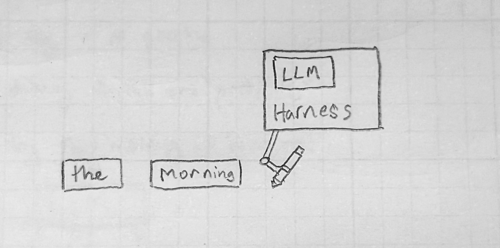
to more or less oversimplify the details, LLMs generate text one
token
(piece of a word) at a time. the system that runs
an LLM is called a harness
, and the harness is responsible for
executing the LLM algorithm over and over and over until it generates the
token that means this is the end of the output
.
but even though the harness generates text one token at a time, the output
of the LLM is actually not just a single token. it's a table, containing
a confidence score
for every single possible token.
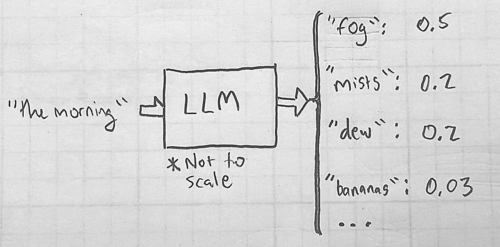
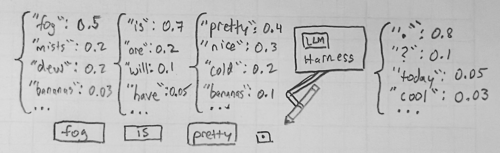
that means the harness has to choose which token to actually use. it might seem logical to always pick the one that the model is most confident about, but if you do this, you tend to get terrible outputs.
to continue oversimplifying things, this is like picking the equivalent of "the fog is pretty" for every sentence, over and over and over.
any specific piece of information might sound somewhat reasonable when communicated in its most likely form, but it sounds really weird if every single thing is. in the worst case, the model will just get stuck in a loop saying the same thing over and over.
in order to avoid this, the harness uses a random number generator to pick a token.
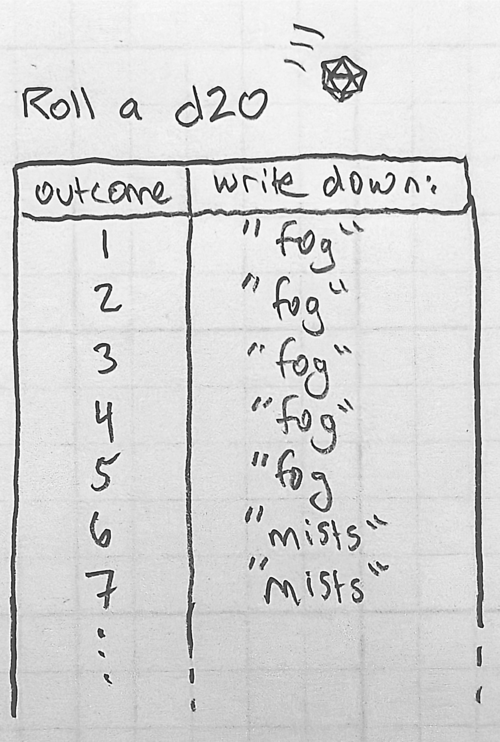
usually, this is set up so that the likelihood of the harness picking a given
token is correlated with the confidence that the model had in that
token. the amount by which the harness can deviate from the most
confident token is set by a parameter which is usually called "temperature"
8.
higher temperature means more variation in
the outputs. lower temperature means the harness sticks to
safer
, more confident tokens.
so what does this mean?
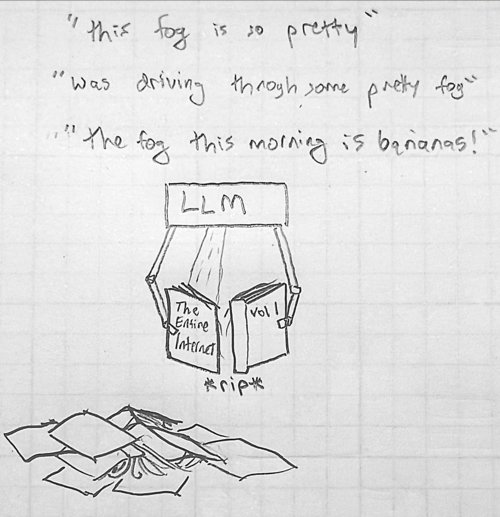
this means that any given sentence of LLM output is a random selection from a distribution of probable sentences.
what makes a given sentence "probable" comes down to two things:
- the sequences of words/tokens encountered in the dataset when the model was trained.
- the initial prompt and the history of the session so far 9 .
if you've only heard the marketing headlines about LLMs, this might be surprising. weren't they supposed to be learning how to escape their containment and hack things? aren't they creating poetry and songs?
when these claims aren't exaggerations or fabrications, they're still obscuring the way that these models fundamentally work—everything in their behaviour is determined by their training data, whatever prompt(s) and conversational history fit within their context window, and a random number generator.
LLMs are taking a random walk through the forest of possibility. their choices are arbitrary, and skewed towards well-trodden paths, when they aren't reproducing training data verbatim.
but why does it matter whether the words are chosen at random? can't a "likely" sentence still communicate something?
a tabletop game is collaborative. the DM and the players are all working together to tell a story, and they each have some basic understanding of what the other people at the table are thinking as they do so.
the game is most fun and most rewarding when the participants are able to anticipate others' reactions. conversely, a game where the DM ignores everything the players do and just rambles about their taxes is probably not going to last very long.
as a matter of fact, all writing is collaborative. 10 as i write this, i have some basic understanding of the kinds of things you might be thinking as you read it. and the purpose of this, the intention i had when i wrote it, is to communicate an idea. by trying to understand your thoughts, and hoping that you will understand mine, i can choose words that i think will help transmit that idea between us.
when an LLM picks words at random, the dice are not being rolled to choose between ideas or concepts motivated by feeling or understanding or purpose. there is no "dungeon master" with a plan for what could happen next.
the dice are being rolled to choose between likely words, based on the words that are in the chat log so far, or the instructions programmed into a harness, or the webpages returned by a search query.
whatever intention exists in writing generated by LLM is only what is put into the prompt. the purpose of the writing, the reason that words were put to computer screen, is obscured, or absent. the LLM cannot collaborate, because the algorithm that the LLM runs on makes no attempt to model what another person would think when they read the words that are being generated.
and when someone reads those generated words, when they imagine the author in their head and try to collaborate with them? there's no one on the other end of the telepathic link.
an intimate lie
if you've been through a secondary-level education, you hopefully have a sense that plagiarism is bad. but i think it's worth discussing why it's bad.
merely copying and reproducing text that someone else wrote is, in a void, a neutral act. in fact, it's the norm when you're quoting somebody. however, we typically say that something is plagiarism when it lacks attribution and is situated to let the reader believe it was the author's own words.
if you copy a joke somebody else made on social media, it may be plagiarism, but it's also a fairly inconsequential instance of it. people who subscribe to your posts who are unfamiliar with the joke may labor under the false impression that you're a comedy genius, but if they ever encounter the original joke and realize you simply copied it, they might feel slightly betrayed.
you would have given them a false impression of who you are by misrepresenting the origin of your words. again, relatively inconsequential, unless that little lie of omission erodes their trust in you to the point of rupturing your relationship.
on the other hand, if you publish a book and it turns out that you plagiarized another book, that could have worse consequences for your writing career and make it very difficult to find another publisher. people who were interested in your writing, including your publisher, will have lost the ability to trust that you were representing yourself faithfully.
the throughline between these examples is trust and identity. by copying something and allowing the reader to believe it was your own, by failing to contextualize it and thus transform it into a part of your own communication, you breach your reader's trust by lying about yourself.
and you also fail to communicate. you fail to create that telepathic connection between you and the reader.
this is why finding out about plagiarism feels like a betrayal. it's an intimate lie. it's a breach of connection that can be felt across vast distances and long stretches of time. it's an indignity against the trust required for a telepathic connection between author and reader.
earlier this year, i had a series of particularly frustrating conversations with a coworker.
this former coworker is not a native english speaker, and would frequently misspell words and use curious grammar when writing in english. i had no problem with that, i still found his messages understandable and was able to communicate and collaborate without issue.
however, he would occasionally message or reply with multiple
paragraphs of text that seemed to have perfect spelling and grammar.
these messages would also often have non-sequitur remarks or discuss
whatever he was replying to as if it was from a third party.
furthermore, there were a number of key phrases
11
and suspiciously recognizable patterns that didn't sound like his writing at
all.
it didn't take long to understand what was happening. he was copying messages from Slack and pasting them into Claude. then, he was copying the output from claude and pasting it back into Slack.
under traditional definitions of plagiarism, this would not be considered plagiarism. the output of Claude was determined by the prompt (my message) but was, i hope, not something that any actual person had ever written word-for-word.
however, it was nonetheless a breach of trust. i was trying to communicate with him, but was instead getting a distorted reflection of my own words.
i tried to tolerate this for a bit, but was eventually so flummoxed that i had to say something. i messaged him privately and asked that he not just paste Claude output into conversations with me. i told him i was fine with spelling and grammar mistakes and could understand his writing without issue. he agreed to stop.
a month or two after, not long before i resigned from that job, i saw our manager (who speaks english fluently!) start doing the same thing.
a destructive copy
nineteen years before Frederic W. H. Myers coined the term "telepathy", while he was still a student at Cambridge, he won a prize for latin poem composition. it was a fairly prestigious prize at the university, and he won it two years in a row. the second time, however, it was rescinded: it turned out he had plagiarized several lines from other prize-winning poems.
he would later describe the incident like so:
Having won a Latin prize poem, I was fond of alluding to myself as a kind of Virgil among my young companions. Writing again a similar poem, I saw in my bookshelves a collection of Oxford prize poems, which I had picked up somewhere in order to gloat over their inferiority to my own. I laid this out on my table and forced into my own new poem such Oxford lines as I deemed worthy of preservation.
whether or not Mr. Myers learned anything from this incident may be a matter of speculation (or the opinions of his biographers). but given that he went on to have a successful career as a lecturer—and researcher of the paranormal—we might assume that the consequences of misrepresenting his work were duly understood.
in August of 2026, rare book librarian Kathryn James reported in The Guardian that Anthropic, seller of the suite of LLM products branded as Claude, was destroying tens or hundreds of thousands of books in order to skirt copyright law and legally obtain them as training data without consulting their authors or publishers 13.
in the court order for Bartz v. Anthropic that James cites, Anthropic's motivation is summarized as follows:
Over time, Anthropic came to value most highly for its data mixes books like the ones Authors had written, and it valued them because of the creative expressions they contained. Claude’s customers wanted Claude to write as accurately and as compellingly as Authors. So, it was best to train the LLMs underlying Claude on works just like the ones Authors had written, with well-curated facts, well-organized analyses, and captivating fictional narratives—above all with
good writingof the kindan editor would approve of(Opp. Exh. 3 at -03433).
i wonder if the people at Anthropic that decided to carry out this
operation shared a little of the attitude of the young Myers. i
wonder if they believed they were deem[ing] [these books] worthy of
preservation
in the form of their language model, even as they destroyed
rare and aged texts and made them that much harder to find.
when a business is built on creating false connections, on fooling people into believing they are communicating when all they're doing is staring into a distorted mirror, real connection becomes a raw material to hoard.
when the product is a random number generator that seems to be better the
more good writing
it's fed, the world's repository of centuries and
millenia of written words, the sum total of telepathic exchange deemed worthy
of publication by millions of people, looks like a resource to be
exploited.
the companies that sell access to LLMs can't seem to decide if what they're selling is a tool, to empower workers and permit creativity; a robot, to replace them; an automatic friend, to offer advice and guidance; or a snake oil salesman, to worm its way into your trust and manipulate you into buying something.
and that's because they are none of the above. to position an LLM as any of those things would imply they are capable of work, of action, of communication, of connection.
LLMs are capable of none of those things. there is no knowledge or wisdom, no mental model of a conversational partner, no understanding beyond word-likelihoods. only a heavily compressed database of words—the most inefficient and destructive database ever conceived.
empty words
earlier, i talked about an empty
feeling i got when playing AI
Dungeon. and i said that i had encountered it prior to
playing the game in 2020.
i've come to recognize that this hollowness in writing that comes from the random walks of language model output is very similar in kind to the hollowness of corporate communications and marketing. perhaps it's no wonder that businesses have embraced these models so enthusiastically.
before about 2023 or so, it could be reliably assumed that even corporate writing had a person behind it, somewhere. but even so, it's writing that operates under false pretenses. it intrudes into the mind with an exuberant tone, demanding attention and permitting only the existence of brand-positivity.
there's no person to connect with on the other side. there's no telepathic link.
LLMs did not create the overwhelming flow of empty communication that surrounds us. but they have made it many times worse, and have driven the emptiness into places it was never previously seen.
i have little patience these days for communication without purpose. despite the destructive actions of companies like Anthropic, the world is utterly filled to the brim with telepathic tomes to peruse, articles and messages and essays to explore and connect with, and so very much that needs to be solved through collaboration and co-operation.
i want to connect with you. and if you've read this far, i believe i have. now, it's your turn.
like i said at the start, i'm telepathic. but the really wild thing is:
you are too.
i'd like to thank my friends Alex and Mercury for beta-reading this essay. your feedback helped me better understand how my telepathic communication would be received.
the descriptions of LLM inner workings are a first-hand account based on having implemented the underlying algorithms for my previous employer. i'm sure if you look up the terms i used, you'll find papers or articles describing them in greater detail. however, i had little desire to find sources on the technical description for the sake of this essay. i've already wasted enough of my precious time on this earth thinking about LLM implementations.